The Complete Guide to Custom Pillow Boxes
A pillow box is one of the simplest structures in folding carton
packaging, and one of the most misused. It is a single piece of board,
die-cut with curved score lines and two fold-in end flaps, that arrives
flat and assembles in under thirty seconds. That simplicity is exactly
why it works so well for small products, and exactly why so many buyers
order the wrong version of it.
Request a custom pillow box quote and we will
size it correctly on the first round.
How a Pillow Box Is Built
Every pillow box shares the same anatomy, whether it holds a ring or a
300-piece promotional kit. Understanding the parts makes specification
decisions obvious.
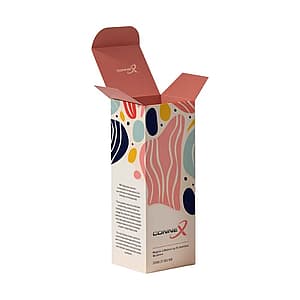
The body panel is the large central surface that wraps
into a tube. It carries almost all of your branding and is the surface
the customer sees first in a retail display. The curved end
flaps are the signature feature — a matched top and bottom flap
at each end of the tube, scored with a concave curve that inverts when
compressed. The pillow creases are those curved score
lines running through the body panel; they are the reason the box bulges
outward instead of staying square, and they are the single most
important technical detail on the dieline.
A glue flap on one side of the flat blank forms the tube
when assembled. Because it is hidden once the box is closed, most designs
leave it unprinted or use it for internal batch codes. On glueless
variants, small tuck tabs extend from one curved flap
and slot behind the opposite flap, holding the box closed through friction
alone.
The practical consequence of this construction is worth stating plainly:
a pillow box has high surface efficiency and almost no structural
strength. It uses less board than a rigid carton of similar external
size, which is why it is inexpensive — and it is why it crushes under
load.
Size, Caliper and the Tolerance Question
Sizing a pillow box looks trivial until you account for the fact that the
board has thickness and the ends are curved. The rule is straightforward:
measure your finished product at its widest point, then add 3–5 mm of
clearance on every axis. The clearance matters most on the height
(end depth), because that is the dimension the curve consumes.
Caliper — the physical thickness of the board — also affects the
internal volume. The same external 4" x 3" x 1" box has slightly less
usable space at 24 pt. than at 12 pt. Our published size chart
lists internal dimensions for an 18 pt. board, which is the most
commonly ordered caliper. If your product is dimension-critical, tell us
the caliper you plan to use and we will confirm the internal dimensions
before we cut a single tool.
The opposite error is just as common: buying a box two sizes too large
so the product "will definitely fit." A loose product shifts in the box,
prints read as sloppy through the gap, and the customer perceives the
packaging as cheap. If you are between two sizes, send us a sample and
we will measure it.
Materials: Matching Board to Brand Position
Material choice on a pillow box is primarily a branding decision, made
within a surprisingly narrow range of substrates. Coated white board is
the default for good reason: it reproduces colour accurately, accepts
gloss, matte and soft-touch lamination cleanly, and gives the sharpest
printed edge.
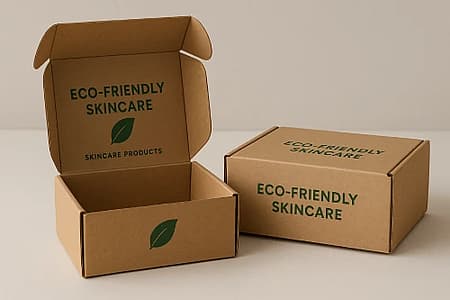
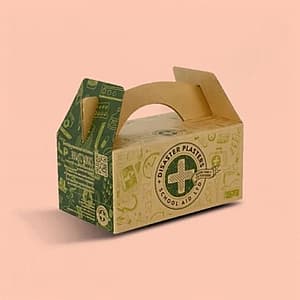
Kraft suits brands positioned as natural, artisanal or environmentally
conscious. Because kraft is uncoated, it absorbs ink slightly and gives a
softer, more tactile result — which many customers read as authentic
rather than unfinished. The trade-off is that saturated CMYK looks
marginally duller on kraft than on coated stock, and kraft shows fibre
variation between production runs. Neither is a defect; both are simply
the material being honest about itself.
Black board produces the highest perceived luxury of any paperboard
option, because foil and metallic inks read as genuinely metallic against
a black ground. It is also the least forgiving: every speck, scratch and
fibre inclusion is visible, so it demands the cleanest handling in the
supply chain. Textured and embossed boards sit between white and black in
positioning, adding tactile interest that justifies a matte finish.
For brands with a formal sustainability position, the material question
is the first one to get right and the easiest one to get wrong in
marketing copy. Fibreboard is broadly recyclable in kerbside paper streams
— the
How2Recycle
guidance for corrugated fibreboard is the reference most widely
recognised in North America. But "our box is recyclable" is a materially
different claim from "our board is FSC certified," and only the second
one requires and supports specific documentation. If you intend to print
a certification mark, request the current chain-of-custody documents for
the specific mill and grade you are ordering. A logo on a box that no
certificate supports is a legal exposure, not a marketing asset.
Printing: CMYK or PMS Spot?
This is a decision buyers routinely get wrong, and it is worth more
attention than it usually receives, because the choice affects both
appearance and cost at every future run.
CMYK (four-colour process) uses cyan, magenta, yellow and
black in halftone combination. It costs nothing extra per colour, handles
photographic imagery and smooth gradients well, and gives a wide colour
gamut. It is the right choice for product photography, illustrations with
many hues, and any design with more than about three colours.
PMS spot inks are pre-mixed, named inks, each printed
from a dedicated plate or cylinder. The colour is exact, the edges are
crisp rather than screened, and — critically — the colour will be
identical on every run for years. That repeatability is why brands with a
defined identity colour specify PMS. The costs are a higher minimum
quantity and a per-ink setup charge, and large solid areas of a very dark
spot ink can show roller marks.
Many commercial projects use both: CMYK for photography and body copy, plus
one PMS ink for the logo. That is the standard specification for a
premium pillow box, and it is what we recommend for jewellery and beauty
work. Pantone maintains the
official
colour matching guidance — work from a physical drawdown, not a screen
value, because no monitor reproduces a spot colour reliably.
Finishes: Where the Perceived Value Comes From
On a 100-unit order, the finish is often a larger driver of perceived
quality than the artwork. It is also where most of the money is spent per
unit, so it is worth understanding what each option does.
Matte lamination diffuses reflected light and produces
the soft, high-end surface most luxury packaging uses. It is also the most
fingerprint-resistant, which matters for a box handled repeatedly. Its
tendency is to slightly flatten contrast, so artwork designed for matte
needs slightly more saturation than the same design for gloss.
Gloss lamination adds brightness and high colour
saturation, and is more scratch-resistant than uncoated board. It shows
fingerprints and it can produce glare under retail lighting, which is a
real problem for a small box with fine text.
Soft-touch lamination has a velvet-like surface that is
unmistakably premium. It is the single most effective upgrade for a
modest budget, and it is the finish most often specified for jewellery
and gift boxes. It cannot be combined with gloss or matte — it replaces
them.
Spot UV applies a raised, gloss varnish to selected areas
— typically a logo or a pattern — over a matte or soft-touch base. The
contrast between the flat and raised areas is what sells it, and it must
be registered accurately or the effect is lost.
Metallic foil stamping applies a thin layer of metallic
foil with a heated die. Genuine foil is a true metal with real
reflectance and is far more expensive than metallic ink, which is
actually a pearlescent pigment and reads as flat under bright light. Foil
cannot be registered to fine detail below roughly 0.5 pt.
Embossing and debossing push the board up or press it
down, creating a raised or recessed element with no ink. It reads as
genuinely premium because the effect is structural rather than printed,
and it works beautifully on textured stock where ink would not.
Windows, Ribbons and Retail Add-Ons
A die-cut window lets the customer see the product without opening the
box, which is a genuine conversion aid for cosmetics and confectionery
where the visual is the sell. The usual choices are a cut-out aperture
with a clear cellulose or polyester film, or an open window with no film
at all. The open version is more sustainable and often looks more
contemporary; the filmed version is more durable and gives a finished
feel. Windows add cost and complicate the dieline, so they are worth
specifying at the quote stage rather than after proofing.
For retail display, a euro-slot or a custom hang tab lets the box hang
from a peg or a wall rail. This is essential if you are supplying a
physical store rather than shipping direct, and it changes the flat blank
geometry, so it must be decided before tooling.
Ribbons and fabric pulls are decorative rather than structural, and they
are labour-intensive, which is why they carry a meaningful minimum. They
suit gift and wedding-adjacent brands, and they are less common in
e-commerce packaging where the box is usually sealed in an outer mailer.
When a Pillow Box Is the Right Choice — and When It Is Not
The most useful thing this page can tell you is when to choose something
else. A pillow box is a presentation format, and forcing it into roles it
was not designed for is the most common packaging mistake we see.
Choose a pillow box when the product is small, light and
rigid; it is being handed to the customer rather than shipped in
isolation; visual presentation at the moment of opening matters more than
transit protection; or you need a low minimum and fast turnaround on a
distinctive shape.
Choose something else when the product is heavy, fragile
or glass-adjacent (use a rigid or rigid-style
box); the box is travelling alone through a courier network (use a
corrugated mailer box);
the product needs a hinged opening or a re-closable mechanism (use a
tuck end box or
slide box); or the contents
are large enough that a one-piece folded carton would be unwieldy (use a
two-piece box with a base
and lid).
Ordering, Proofing and Lead Times
Our minimum order quantity is 100 units, which is genuinely the entry
point at which custom die-cutting is economic — below that, tooling cost
per box is prohibitive. Standard production is 15–18 business days after
artwork approval, with rush available on most runs. Shipping is free
within the United States, and we ship internationally.
The process is deliberately simple. You send dimensions, quantity,
material and artwork — or use our
quote request form and upload your design
directly. We return a digital proof for approval, and prepress checks
artwork for bleed, safe zone, colour mode and resolution at no charge. No
plates or sheets are committed until you approve the proof in writing.
If you want to hold a physical box before committing to a full run, ask
for a white-sample or a printed sample when you request your quote.
For broader questions about materials, lead times and shipping that apply
across every product we make, our
packaging FAQs cover the general ground, and you can
read about how we manufacture before you place an
order.