Custom Kraft Boxes: A Practical Guide to Material, Sizing, Printing, and Cost
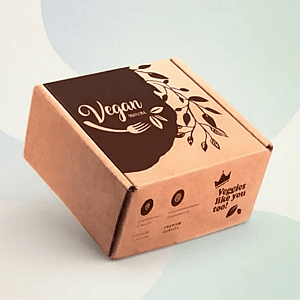
Kraft boxes have become the default answer for small and mid-sized brands that
want packaging to look considered without committing to a rigid box budget. The
reason is straightforward: unbleached kraft paper delivers a warm, printed-for-you
appearance at a lower material cost than coated white board, and it carries a
recycled-content story that customers already understand without explanation.
What kraft does not give you for free is precision. Kraft board is absorbent, its
colour shifts under ink, and its strength comes from caliper and flute rather than
from a number printed on a spec sheet. This guide covers what actually changes
when you move from a standard carton to a made-to-measure kraft box.
What kraft paper actually is
Kraft paper is unbleached paperboard. The name comes from the German
kräftig, meaning strong, and it reflects the sulphate pulping process that
leaves the long-fibre lignin in the pulp instead of bleaching it away. That
retained lignin is why kraft is stronger than recycled white paperboard of the same
thickness and why it does not go yellow in storage.
Two things follow from this that matter commercially. First, kraft is brown by
default and it is not a coating that can be printed over — the colour is the
fibre. Second, kraft is porous, which is precisely why the brown reads as natural
and unprocessed, and precisely why it interferes with ink.
You will see three variants in quotes. Natural brown kraft is the unbleached
stock. White kraft is kraft with a white clay or calcium-carbonate base applied to
one face, which gives you a printable white surface while keeping the recycled
core. Recycled kraft is made predominantly from post-consumer recovered fibre,
which is where most of the environmental claim lives. If you intend to print "FSC
certified" or "100% recycled" on the box, ask for the chain-of-custody
certificate number and put it on the panel where you claim it.
Kraft box styles and when each one is correct
The style choice is a labour decision before it is a design decision. Structure
determines how long it takes to pack one unit, and pack time is usually a bigger
cost than the board itself.
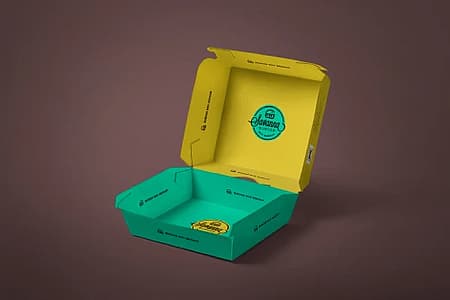
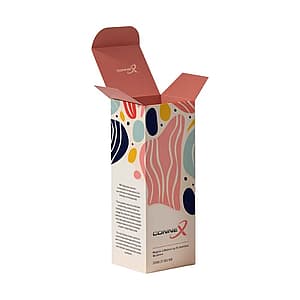
Tuck end cartons are the cheapest structure in production. They
ship flat as a single die-cut blank, fold up in about three seconds, and need a
strip of tape or a hot glue gun. For retail shelf stock under roughly 50 units a
day, this is almost always the right answer. The reverse tuck variant, where the
front and back closures fold in opposite directions, resists side compression and
is worth the negligible cost premium for anything on a shelf that gets restocked
roughly.
Auto-lock bottom boxes cost 15 to 25 percent more per unit and
cut assembly to a single motion with no tape. If your packing operation runs at
200 or more units a day, the labour saving usually exceeds the material premium
within the first production run. Below that threshold the premium rarely pays for
itself.
One-piece mailers need no assembly at all, which is why they
dominate direct-to-consumer shipping. They also carry a weight penalty: the whole
structure is in the panel rather than concentrated in the base, so the same product
needs a heavier board in a mailer than it would in a carton with a separate top.
See our kraft mailer box range for
the caliper-to-weight mapping.
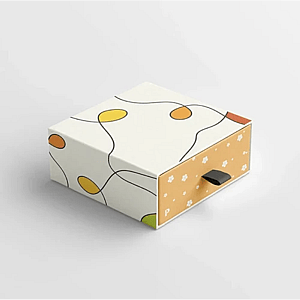
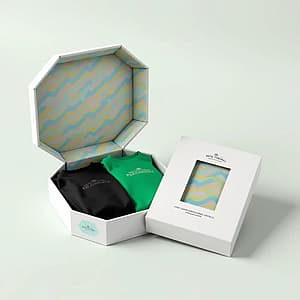
Two-piece and sleeve boxes separate branding from structure. A
printed outer sleeve slips over a plain inner tray. This is the most economical way
to get a premium open-box presentation, and it lets you change the sleeve artwork
seasonally without reordering the tray.
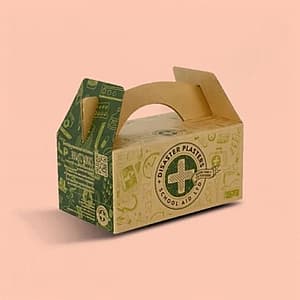
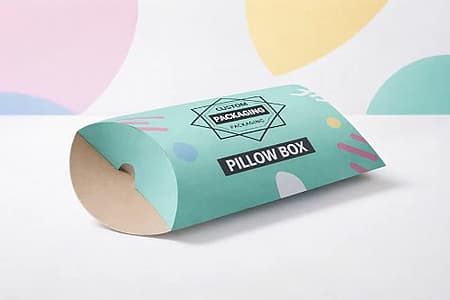
Pillow boxes and gable boxes are presentation
styles. Pillow boxes work for soft-sided, low-weight goods. Gable boxes carry a
built-in handle and suit food service and gifting, where the handle removes the
need for a separate bag.
Choosing caliper, flute, and wall strength
Caliper is thickness in points, and on its own it is a poor proxy for strength.
What actually governs load capacity is edge crush test, or ECT, measured in pounds
per inch of edge. Two 24pt boards from different mills can differ meaningfully in
ECT because fibre length and refining differ.
| Structure | Typical ECT | Safe working load | Fits |
|---|
| 18–24 pt kraft card | Not flute-rated | Under 2 lb | Soap, cosmetics, candles, apparel, samples |
| Single-wall E-flute | 30–40 lb/in | Up to 5 lb | Shoes, folded apparel, thin parcels, print-heavy panels |
| Single-wall B-flute | 44–55 lb/in | Up to 20 lb | Glassware, canned goods, multi-item kits |
| Single-wall C-flute | 40–50 lb/in | Up to 40 lb | General shipping, distribution, cost-first projects |
| Double-wall BC | 58–70 lb/in | Up to 100 lb | Furniture, automotive, warehouse, heavy kits |
E-flute deserves special mention because it is frequently misunderstood. It is
the thinnest corrugated profile at roughly 1.5 mm, and its large flute means a broad
print surface with almost no flute shadow. That makes it the best choice for
heavily illustrated boxes where C-flute would show ribbing through the artwork. The
trade-off is edge crush: it is the weakest profile, and it flexes. It is not the
right board for a heavy glass bottle that travels in a parcel network.
Rule of thumb: if your product can be dropped from waist height onto concrete and
survive, and the total packed weight is under 5 lb, E-flute is sufficient. Past
that, step up to B or C single-wall.
Sizing a kraft box correctly
Most oversizing errors trace back to a supplier quoting external dimensions.
Always confirm internal dimensions. Then work from the product, not from the
product's retail packaging.
- Measure length as the longest face, width as the shortest face, depth perpendicular to both.
- Add 1/8 inch of clearance to length, width, and depth for a total of about 1/4 inch of slack on the two larger faces.
- Account for rigid inserts. A moulded pulp tray or a corrugated pad has real thickness, and that thickness comes out of your usable internal volume.
- Check dimensional weight against actual weight before you finalise. See the corrugated box guide for carrier divisors.
- Order one physical sample at production board grade before committing to a run. Board calipers vary between mills, and a same-numbered board can fit differently.
For multi-item sets, add 3 mm between components so parts do not rub in transit.
For jars, bottles, and glass, plan on a fitted insert rather than loose packing.
The insert costs less than the returns it prevents.
Printing on kraft: why colours shift and how to control it
Kraft is absorbent and porous. Ink soaks into the surface rather than sitting on
it, which raises apparent colour density unevenly and pulls light colours toward the
brown underneath. This is a substrate behaviour, not a press defect, and it is why
the same CMYK build looks different on kraft and on coated white board.
Four rules resolve most kraft print problems.
Use spot colour when accuracy matters. One or two Pantone inks
print far more consistently on kraft than a four-colour build. Your CMYK blue on
kraft will not match your CMYK blue on your website, and no amount of proofing
changes that.
Never request white in a four-colour build. CMYK has no white.
A white logo on kraft requires a spot white ink or a knocked-out white base, and it
should be specified as such.
Go dark and saturated, or knock out first. Mid-tone blues,
mint greens, and pastels disappear into brown. Use a saturated navy, forest green,
charcoal, or deep burgundy. For a light palette, lay down white and print over it,
which costs an extra pass.
Raise minimum line weights. Keep strokes above 0.75 pt and avoid
hairline serifs. On an absorbent, uncoated surface, fine detail fills in during the
drying process.
For finishing, matte aqueous coating smooths the surface and improves colour
consistency without killing the natural look. Gloss reads as plastic on kraft and
fights the sustainability signal. Spot UV is the strongest option for a premium
finish: it adds gloss only where your logo sits, giving contrast against the matte
field. Foil stamping in copper, gold, or silver gives a premium result on kraft
because the metallic reads strongly against matte brown.
Food safety and environmental claims
Uncoated kraft is generally considered suitable for direct food contact, but
"food safe" is not a complete answer. It describes contact safety, not barrier
performance. Uncoated kraft is a poor grease and moisture barrier, so a direct
food-contact box for fried, oily, or wet products needs an added barrier: a wax
liner, a grease-resistant aqueous coating, or an oil-resistant treatment.
For your printed claims, the relevant standards are the FTC Green Guides, which
govern environmental marketing claims in the United States, and the BPI
certification for compostability. A box can be 100 percent recyclable and still not
be certified compostable, because industrial composting requires the whole product,
including inks, coatings, and window film, to break down under specific conditions.
If you intend to claim compostability, ask for the certificate number rather than
accepting the word on a sales page.
For our broader food and
beverage packaging range, barrier options are specified per product rather than
assumed.
What kraft boxes cost, and where the money actually goes
Two costs sit on a custom packaging quote: setup and
board. Setup is the one-time cost of the cutting die and the press
preparation. Board is the per-unit cost that scales with your quantity.
Because setup is fixed, per-unit cost falls steeply as quantity rises. This has a
practical consequence for small formats that is rarely explained by suppliers: on a
small box, setup can dominate. You may be buying a dieline and a press run more
than you are buying board. The correct strategy on small boxes is therefore volume
or shared tooling, not thinner board. Dropping from 18 pt to 14 pt saves a few
cents and often costs more in damaged goods than it saves in material.
The other cost lever people miss is dimensional weight. On a shipping box, the
per-unit board saving from a slightly larger box is frequently wiped out by the
carrier charge for shipping a larger box.
We publish full pricing ranges across our custom
box range, and quote per-size rather than a single "from" figure.
How to order custom kraft boxes
- Send product dimensions and quantity. Weight and shipping destination both change the quote.
- Choose a style and board grade. Use the table above; if you are unsure, quote a tuck end carton in recycled kraft card as the baseline.
- Approve the dieline. We supply the flat layout with fold, cut, and safe zones marked. Nothing goes to press before this is signed off.
- Upload print-ready artwork. PDF/X-1a or X-4, 300 DPI, 3 mm bleed, vector logos.
- Review the physical proof. One production-grade sample before the full run. This step catches colour problems no flat proof can.
- Approve and produce. 15 to 18 business days after dieline sign-off, shipped flat and bundled.
Ready to price your box? Use the quote form above with your dimensions and
quantity, or browse apparel boxes,
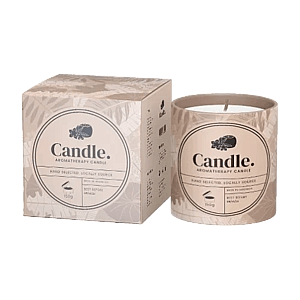
candle boxes, and
CBD packaging for
category-specific sizing guidance.