Learn More: The Complete Guide to Custom Business Cards
Choosing business card stock is easy once you know the difference between a point and a gram, and building a print-ready file is straightforward once you know what a bleed line is. The difficulty is that almost nobody explains either. This guide covers every decision you face when ordering custom business cards — size, stock weight, finishes and file setup — in plain language, so you can specify exactly what you want and avoid the corrections that cost a production week.
Why Most Business Card Orders Fail Before They Reach the Press
The majority of reprinted business card jobs are not rejected for a bad design. They are rejected for technical reasons that are invisible on a screen: artwork that stops short of the bleed line, text sitting inside the guillotine's tolerance, an RGB image where CMYK was required, or a foil area that was never defined as a spot channel. Each of these is fixable in minutes — but only if you know they exist before you upload.
A useful way to think about a business card order is that you are specifying three separate things: the shape of the card, the material it is made from, and the surface treatments applied to it. Printers use different terminology for each. Get those three vocabularies straight and you can read any quote you receive, including ours, without guessing.
1. Choosing the Right Business Card Size
Business card sizes are not standardised globally. They evolved independently in each region to fit local wallets, and the differences are small enough to look like an error rather than a convention. There are two dominant standards and a long tail of national variants.
US & Canada standard: 3.5 x 2 in (89 x 51 mm)
This is the default in North America. At 88.9 x 50.8 mm it sits slightly larger than an ISO 7810 ID-1 credit card (85.6 x 53.98 mm) — narrower and shorter than a payment card — and it fits standard wallets, card holders, Rolodex slots and back-pocket dividers. If you hand out cards in the United States, Canada or Mexico, use this size. Design software in the US defaults to it, so templates are easier to find.
European and UK standard: 85 x 55 mm (3.35 x 2.17 in)
Across the UK, Ireland, France, Germany, Italy, Spain, the Netherlands and most of Europe, the standard card is 85 x 55 mm. It is marginally narrower and taller than the US card — 3.9 mm narrower, 4.2 mm taller — and its proportions are close enough to a credit card that it drops into the same wallet slot. Neighbouring markets vary: much of Scandinavia uses 90 x 55 mm, and some German printers still offer 85 x 55 mm as the default rather than a locally preferred size.
One US card in a European card holder sits about 4 mm proud of the edge. A European card in the US reads as slightly square. Neither is a mistake, but both are noticeable, and that is the whole argument for printing regional sizes separately.
Japan, Australia, China and the wider world
Japan uses 91 x 55 mm formeishi — traditional business cards, which carry a different set of conventions to Western cards and should be designed on their own terms. Australia, New Zealand and much of Southeast Asia use 90 x 55 mm. China, Hong Kong and Singapore use 90 x 54 mm. Iran uses 85 x 48 mm. If your customer base is genuinely international, the safest single compromise is 85 x 55 mm, which fits the widest range of card holders worldwide.
Square, slim and die-cut alternatives
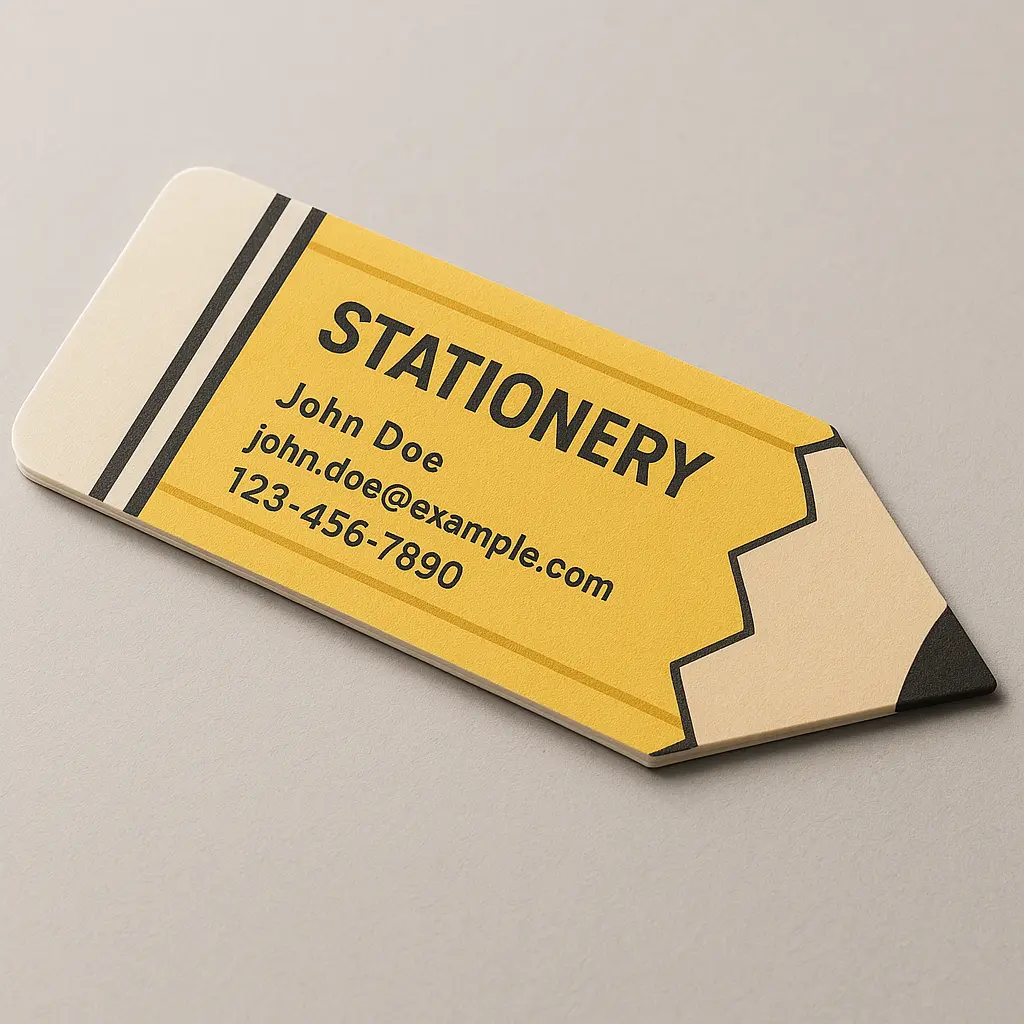
Beyond the regional standards, the formats below are genuinely popular and worth considering for specific briefs. Each needs its own die, which is why custom sizes carry a longer lead time than standard trim.
Standard and alternative business card sizes
| Size |
Metric |
Pixels at 300 dpi |
Best used for |
|---|
| 3.5 x 2 in |
88.9 x 50.8 mm |
1050 x 600 |
US and Canadian standard; default choice for most briefs |
|---|
| 3.35 x 2.17 in |
85 x 55 mm |
1004 x 650 |
UK and European standard; close match to ISO 7810 ID-1 |
|---|
| 3.58 x 2.17 in |
91 x 55 mm |
1075 x 650 |
Japanese meishi |
|---|
| 3.54 x 2.17 in |
90 x 55 mm |
1063 x 650 |
Australia, New Zealand, Scandinavia, much of Southeast Asia |
|---|
| 3.54 x 2.13 in |
90 x 54 mm |
1063 x 638 |
China, Hong Kong, Singapore |
|---|
| 2.5 x 2.5 in |
63.5 x 63.5 mm |
750 x 750 |
Creative studios and modern brands; fits square card holders |
|---|
| 3.5 x 1.75 in |
88.9 x 44.5 mm |
1050 x 525 |
Slim vertical cards, loyalty and appointment cards |
|---|
| 2.91 x 2.05 in |
74 x 52 mm |
874 x 614 |
ISO 216 A8 — the smallest conventional business card |
|---|
2. Paper Stock: Point, GSM and Pound Weights Explained
This is where buyers most often lose confidence, because three measurement systems are in circulation and none of them translate cleanly into each other.
What "14 pt" actually means
A point measures physical thickness, or caliper. One point is one thousandth of an inch. A 14 pt card is therefore exactly 0.014 inches (0.36 mm) thick;16 pt is 0.016 inches, 18 pt is 0.018 inches, and 32 pt is 0.032 inches. There is no hidden arithmetic. The distinction between 14 pt and 16 pt is two thousandths of an inch — a margin thinner than a sheet of paper — and yet almost everyone notices the difference the moment they pick the cards up.
Why pt, GSM and lb are not interchangeable
GSM is the international weight standard: how many grams one square metre of the sheet weighs. Pound weight is a US system based on the weight of 500 sheets of a given parent size — and because the parent size changes with paper category, "100 lb cover" and "100 lb text" describe sheets of different thickness. Neither lb nor GSM measures thickness directly.
The practical consequence is that two cards described as the same GSM can feel quite different. An uncoated cotton board is bulkier than a coated sheet at identical weight, so a 350 gsm cotton card reads thicker in the hand than a 350 gsm coated one. As a rule of thumb for coated cover stock:
Business card stock weights compared
| Stock |
Caliper |
Approx. GSM |
How it feels |
Best for |
|---|
| 12 pt |
0.012 in |
260–275 |
Light, still slightly flexible |
Large promotional runs, short-lived giveaways |
|---|
| 14 pt C2S |
0.014 in |
300–350 |
The familiar workhorse; firm, wallet-friendly |
Default choice for most businesses |
|---|
| 16 pt C2S |
0.016 in |
350–400 |
Noticeably sturdier, still comfortable |
Professional services, sales teams, client-facing staff |
|---|
| 18 pt C1S |
0.018 in |
400–450 |
Substantial; holds a crisp edge |
Appointment cards and referral cards written on the back |
|---|
| 32 pt bonded |
0.032 in |
600–800 |
Rigid, roughly credit-card thickness |
Luxury retail, hospitality, painted-edge finishes |
|---|
| 48 pt triplex |
0.048 in |
800–1,200 |
Substantial, visible coloured core seam |
Executive and premium-brand positioning |
|---|
Coated (C2S) versus uncoated (C1S)
C2S means coated on two sides, which is the default for printed business cards because coatings hold colour and let finishes adhere cleanly. C1S leaves one side uncoated, and is what you want for appointment cards, referral cards and anything a receptionist writes on. If people will put a pen on the back of your card, tell your printer you want an uncoated back — gloss and UV coatings will not take ink cleanly.
More From Thepackhive
Business cards do a lot of work on their own, and more once they arrive with something.
If you are building out a brand rather than restocking an office, these are the products
that pair with them most often.
-
Shipping your product in something worth remembering. Custom
corrugated boxes in single, double or
triple wall, with your print and logo, so the unboxing matches the card handover.
-
The most common e-commerce pairing. Custom
mailer boxes printed to match, for brands
shipping subscription and DTC orders.
-
For high-value retail. Rigid boxes
with soft-touch lamination and foil — the same finishing vocabulary as a premium
card, applied at a larger scale.
-
Adding a tactile layer. Custom
stickers and labels and
product labels printed on the same stocks.
-
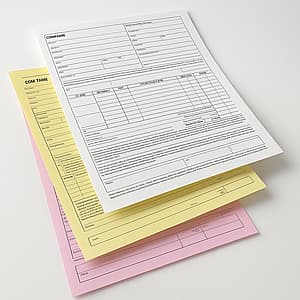
For client intake.
Custom carbonless forms
when the card is followed immediately by paperwork.
-
Browsing the full range. Our complete
packaging boxes collection.
About Thepackhive — how we print, who we print for, and the
equipment behind every order. You can also read our broader
printing FAQs.