
Designed to fit your product dimensions, style, and brand identity.

High-quality printing, premium finishes.
Carbonless forms look like ordinary paper until you write on them. What most buyers do not know is that the copy is manufactured at the moment of contact by a chemical reaction inside two coatings, not transferred from anything. Understanding how that works explains almost every practical question you will have later: why copies fade, why the fourth part is lighter than the first, why a hard surface matters, and why some forms will not feed through a laser printer.
Carbonless paper is coated stock that duplicates what is written on it without carbon paper between the sheets. The name NCR stands for No Carbon Required, and it comes from the National Cash Register company, whose engineers developed the process in the early 1950s. Carbonless forms and NCR forms are two names for the same product, and any supplier using both is not describing two different things.
A multi-part set is built from sheets that each carry a different coating, identified by a standard code. Understanding these three codes is the fastest way to read any carbonless spec sheet you have ever been sent.
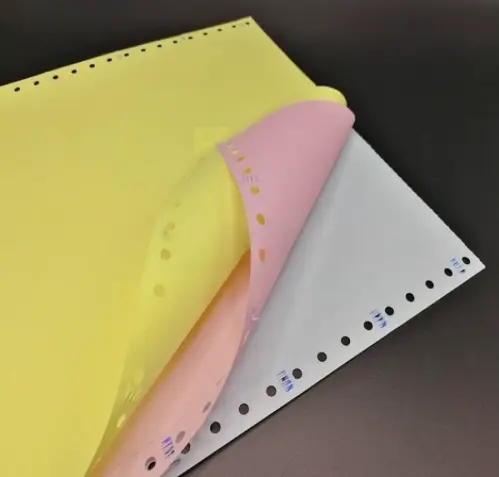
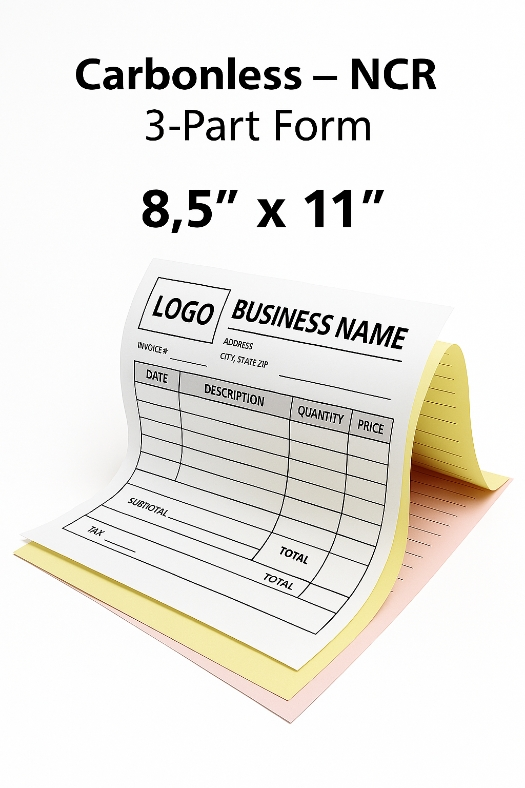
A standard 3-part set is therefore white CB on top, yellow CFB in the middle, and pink CF on the bottom. When you see a colour sequence quoted in reverse, that describes the order the sheets are collated in on the press, not a different product.
The coating on the back of the top sheet holds microscopic capsules of colourless dye suspended in an oil. The capsule walls are thin enough to survive printing, handling, folding, and years of storage, but they break under the concentrated pressure of a pen stroke, a typewriter key, or an impact print head.
When the capsules rupture, the dye escapes onto the reactive clay coating on the sheet below. The two chemicals react and form a solid, permanent mark. The image is created on the receiving sheet rather than moved to it. That single fact is why carbonless forms do not smear, do not transfer onto fingers and clothing, and leave no carbon residue in a drawer.
Four practical consequences follow directly from this mechanism, and each one explains something you may already have experienced:
Carbon paper and carbonless forms solve the same problem and are often treated as interchangeable. They are not, and the differences matter if you handle customer financial documents.
| Consideration | Carbon paper | Carbonless forms | Copy paper |
|---|---|---|---|
| How the copy is made | Dark pigment is physically transferred between sheets | Chemical reaction creates the image on the sheet below | Reprinted at a second device |
| Hand and clothing residue | Yes, a recurring problem | None | None |
| Confidentiality | Poor. The carbon sheet retains a readable image of the last entry | Good. No retained master copy exists | Depends on your disposal process |
| Image clarity | Heavy, often smudged | Clean and permanent, lighter on later parts | Full clarity on every copy |
| Copies per stroke | Two, or three with two carbon sheets | Two to five | Unlimited, one at a time |
| Needs a device | No | No | Yes |
| Typical cost per transaction | Lowest | Mid. Falls sharply at volume | Highest once paper, toner, and time are counted |
Ordinary copy paper wins on one axis only: every copy is equally clear. It loses everywhere else. It requires a device, it doubles the handling, and the second copy is produced minutes later by a different person, which is exactly when transcription errors enter your records.
Digital invoicing and e-signature platforms have taken over the back office, and for many businesses that is the better answer. Carbonless forms persist where a device is not an option: a technician writing a work order in a crawlspace, a driver handing a delivery note at a gate, a cashier at a counter with no terminal. If your paperwork happens away from a computer, carbonless forms remain the most reliable mechanism available.
The number of parts is simply the number of copies produced at once, including the original. The right choice comes down to how many people need a copy and what each one does with it.
Start with 2-part. One copy for the customer, one for your files. Most receipts, delivery notes, and short transactions need nothing more. It is the cheapest configuration per set and it keeps copies dark, because the second sheet receives the image with minimal loss.
Move to 3-part when a second copy has to go somewhere separate from your accounts file. The common pattern is original to the customer, first duplicate to accounts receivable, second duplicate to the salesperson, the technician, or the department that needs to act on the job. Work orders and service tickets usually need this.
Choose 4-part only when four genuinely distinct people or systems must receive the document. Multi-location businesses routing a job to dispatch, workshop, quality control, and billing can justify it. Remember that the goldenrod copy will be the faintest, so assign it to the role that needs the least detail.
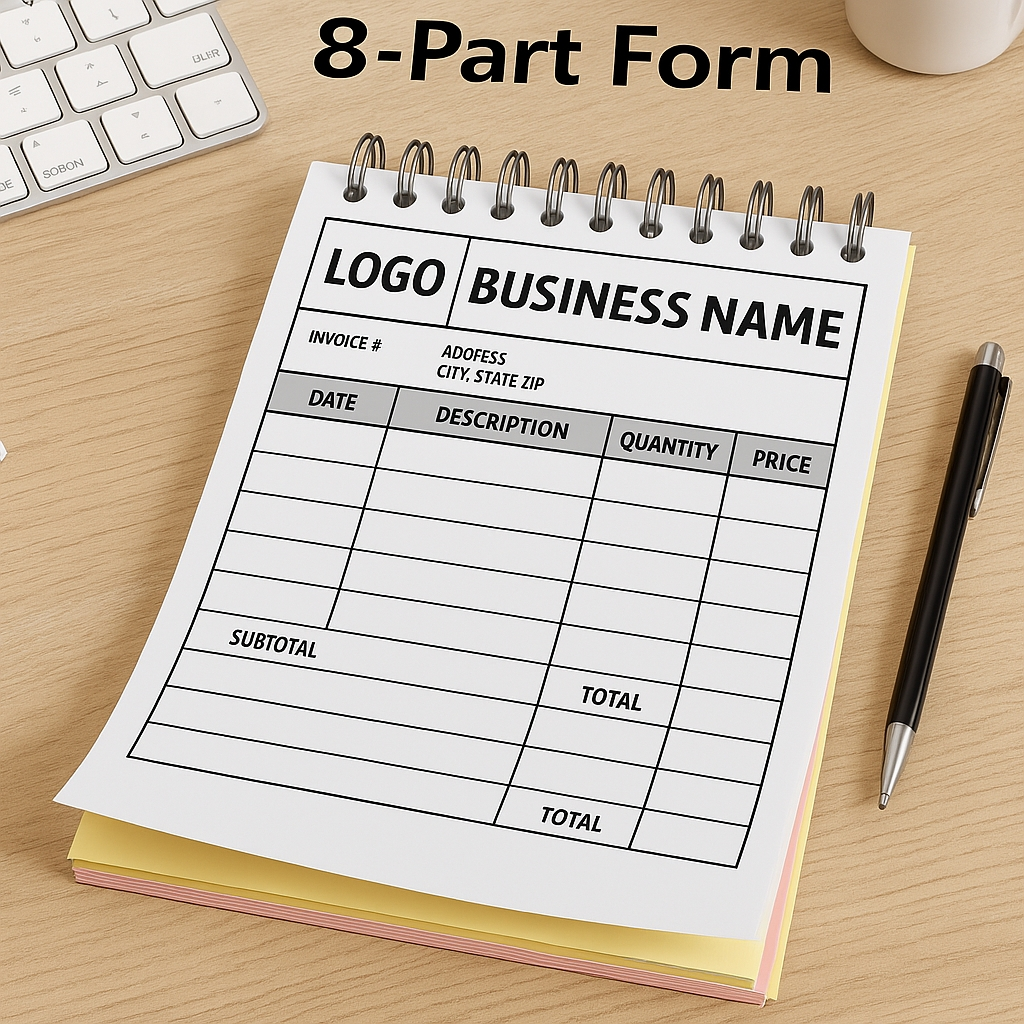
Going beyond four parts is technically possible but rarely worth it. By the fifth or sixth sheet the image is often too light to read reliably, and you are paying for paper to produce records nobody can use. If you genuinely need six copies, ask us about a heavier tag-stock bottom sheet to improve the final copy.
This is the question suppliers rarely answer, so here is a direct mapping from business type to configuration.
| Business or use | Parts | Size | Binding | Also consider |
|---|---|---|---|---|
| Retail counter receipts | 2-part | 4.25" × 5.5" | Glued pad | Sequential numbering |
| Field service and repair | 3-part | 8.5" × 11" | Glued pad | Perforation, 2-hole punch |
| Delivery and logistics | 3-part | 5.5" × 8.5" | Loose sets | Signature block, barcode |
| Wholesale and distribution invoicing | 4-part | 8.5" × 11" | Booklet | Different wording per part |
| Construction and trades | 3-part | 8.5" × 11" | Loose sets | Job number field, wrap-around cover |
| Medical and compliance | 3-part | 8.5" × 11" | Booklet | Record-retention wording per part |
| Freight and shipping | 4-part | 8.5" × 14" | Loose sets | Bills of lading format |
| Sales orders | 3-part | 8.5" × 11" | Glued pad | Consecutive numbering in red |
Paper weight. The standard is 20 lb. Some suppliers offer 15 lb to hit a lower price point. The trade-off is real: 15 lb stock is thinner, splits at glued edges after less use, is harder to write on without a hard surface, and is generally not rated for laser printing. Premium NCR stock also matters for a non-obvious reason. Heavier paper resists capsule damage during handling and folding, so your forms still image correctly after months of storage.
Binding. Glued edge is the most common choice because sets tear off cleanly one at a time. Stapled booklets keep a whole run together and suit job packets or anything that gets filed as a unit. Loose sets are right when forms are inserted into an existing filing system.
Sequential numbering. Consecutive numbers let you prove that no form was skipped or duplicated, which matters during an audit or a dispute. Red numbering is the industry convention because it is visually distinct from any content printed in black. Barcodes do the same job faster if you file into an accounting system.
Backside printing. You can print on the reverse of every part, which is how terms and conditions get onto a form. One warning: ink on the reverse can show faintly through to the front. Suppliers reduce this by screening the back to roughly 30 to 50 percent coverage or by switching to solid black on heavier stock. Ask what your supplier does before approving a double-sided file.
File preparation and the print-safe zone. This is the most common reason a carbonless order needs reprinting. NCR forms are printed on the finished size rather than on a larger press sheet, so the press needs a gripper area to hold the paper. Allow a minimum of 0.25" of clear margin on every edge and keep all text and logos inside it. Logos, full-bleed backgrounds, and trim marks pushed to the paper edge will be clipped or distorted. Supply vector artwork where you can, and we will return a proof for approval before anything runs.
Most carbonless problems trace back to pressure, storage, or a paper grade mismatch. Here are the causes we see repeatedly, in the order we see them.
Still not resolved? Send us a photo of the completed set and the details of how it was filled in. If the order came from us, we will make it right.
Most reorder delays come from a decision that could have been made earlier: how many copies a single stroke needs to produce. Count the people and systems that must receive the document, add nothing, and that is your part count. Then choose the smallest size that holds your fields without shrinking type below legibility. Everything else on this page is a preference you can change later. Part count and size are much harder to change once a system is built around them.
Questions about a specific configuration? Request a custom quote and describe what you are trying to capture. If you are still deciding, our general printing FAQs cover file formats, proofs, and shipping. For brand-consistent collateral to go out with the forms, see our packaging design and branding service or custom business cards that match the letterhead you have just designed.
Get a quote for custom carbonless NCR forms — 100-set minimum, proof before press, 15 to 18 business day turnaround, and free ground shipping within the USA.
Every configuration below is available on our custom carbonless NCR forms. Upload your artwork or work from a template, and we will return a digital proof before anything goes on press. If you need a specification that is not listed here, request a quote and tell us what you are trying to achieve.
| Specification | Details |
|---|---|
| Form types | Invoice forms, work orders, receipts, purchase orders, delivery notes, bills of lading, field service tickets, and custom layouts |
| Number of parts | 2-part (white and yellow), 3-part (white, yellow, and pink), 4-part (white, yellow, pink, and goldenrod) |
| Finished sizes | 4.25" × 5.5" (quarter size), 5.5" × 8.5" (half size), 8.5" × 11" (letter), 8.5" × 14" (legal). Custom sizes available on request. |
| Paper stock | Premium NCR (no carbon required) carbonless paper. See how paper weight changes performance. |
| Binding options | Glued edge (pad), stapled booklet with wrap-around cover, or loose sets |
| Printing | Full colour (process or spot), black only, or black plus up to four spot colours. Single-sided or double-sided. |
| Sequential numbering | Optional. Red or black ink, positioned anywhere on the sheet. Crash numbering available. |
| Finishing options | Perforation, hole punching (2-hole and 3-hole), wrap-around covers, and folding |
| Barcode printing | Consecutive barcodes for tracking and accounts receivable filing |
| Minimum order | 100 sets |
| Production time | 15 to 18 business days after proof approval. Rush service available on request. |
| Shipping | Free ground shipping within the USA. International shipping available. |
| Artwork requirements | Print-ready PDF preferred. We will also work from DOC, AI, EPS, or PNG. Allow a 0.25" print-safe margin on all edges. Read our file preparation notes. |
| Price From | As Low as $0.10 Per Piece |
The same carbonless stock and part counts apply to every layout below. Choose the structure that matches how your team already fills in forms.
The number of parts is the number of identical copies produced in a single stroke. Standard colour sequences are listed below. Non-standard sequences are available if your filing system requires a specific colour in a specific position.
Printing different wording on each part is possible. For example, part one can read Customer copy while part two reads Accounts receivable copy and part three reads Sales copy. This is the single most useful finishing option for multi-department businesses and it is worth paying for.
Choose the size that fits the transaction, not the size that fits your printer. A full letter-size set on a counter is slow to fill out; a quarter size is fast but cannot hold a detailed invoice.
Carbonless paper is sold by weight, and the weight matters more than most buyers expect. 20 lb is the industry standard for custom business forms. Some suppliers quote 15 lb because it is cheaper to print and cheaper to ship, but 15 lb is thinner, tears at glued edges sooner, and is generally not laser-compatible. Ask any supplier which weight they are quoting before you compare prices.
Send print-ready artwork and we will return a PDF proof for approval before production. Nothing goes on press until you approve it. Barcode numbering can be printed as a barcode alone, a number alone, or both together, which makes filing into an accounting system far faster than reading handwritten numbers.
This is an alert message.